
Flashing guide
Roof Flashing: Where It Goes and Why It Leaks
Roofs leak most often at the metal joints, not out in the open field of shingle or tile. Here is where each piece sits, what makes it fail and how we rebuild it so the water stops.
Free, no-obligation estimates. We answer every day of the week, and voicemail after hours is returned the next working morning.
Flashing, defined
What roof flashing does
Roof flashing is the metal that seals the joints where the roof meets walls, chimneys, valleys, skylights and pipes.
Shingle and tile shed water well across an open slope. At a joint the roofing has to stop, turn or let something through, and bent sheet metal laps over and under the courses there so the water keeps running downhill instead of into the house. Homeowners call it the "roof metal" or the metal around the chimney.
The details for each joint are set out in the National Roofing Contractors Association (NRCA) Roofing Manual, the reference roofers work from for flashing and slope minimums.
Custom sheet-metal parts
Some joints take metal cut and bent for that roof rather than a stock piece.
- Drip edges
- Chimney shrouds
- Valleys
- Door pans
Where each piece goes
Step, counter, valley, skylight and edge flashing
The main kinds are "step flashing" at walls, "counterflashing" over it, valley metal, pipe boots and "drip edge" at the eaves.
-
Step flashing
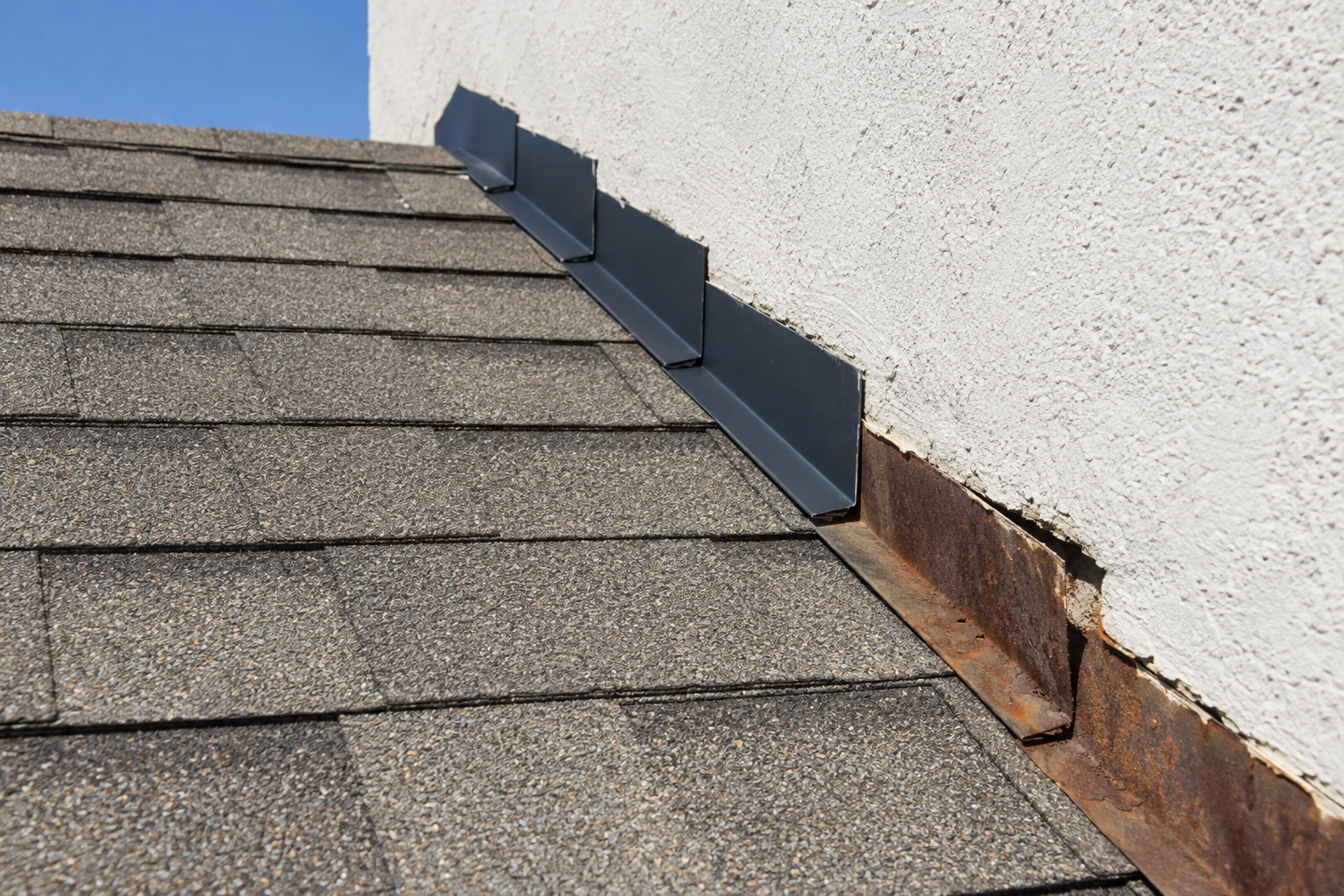
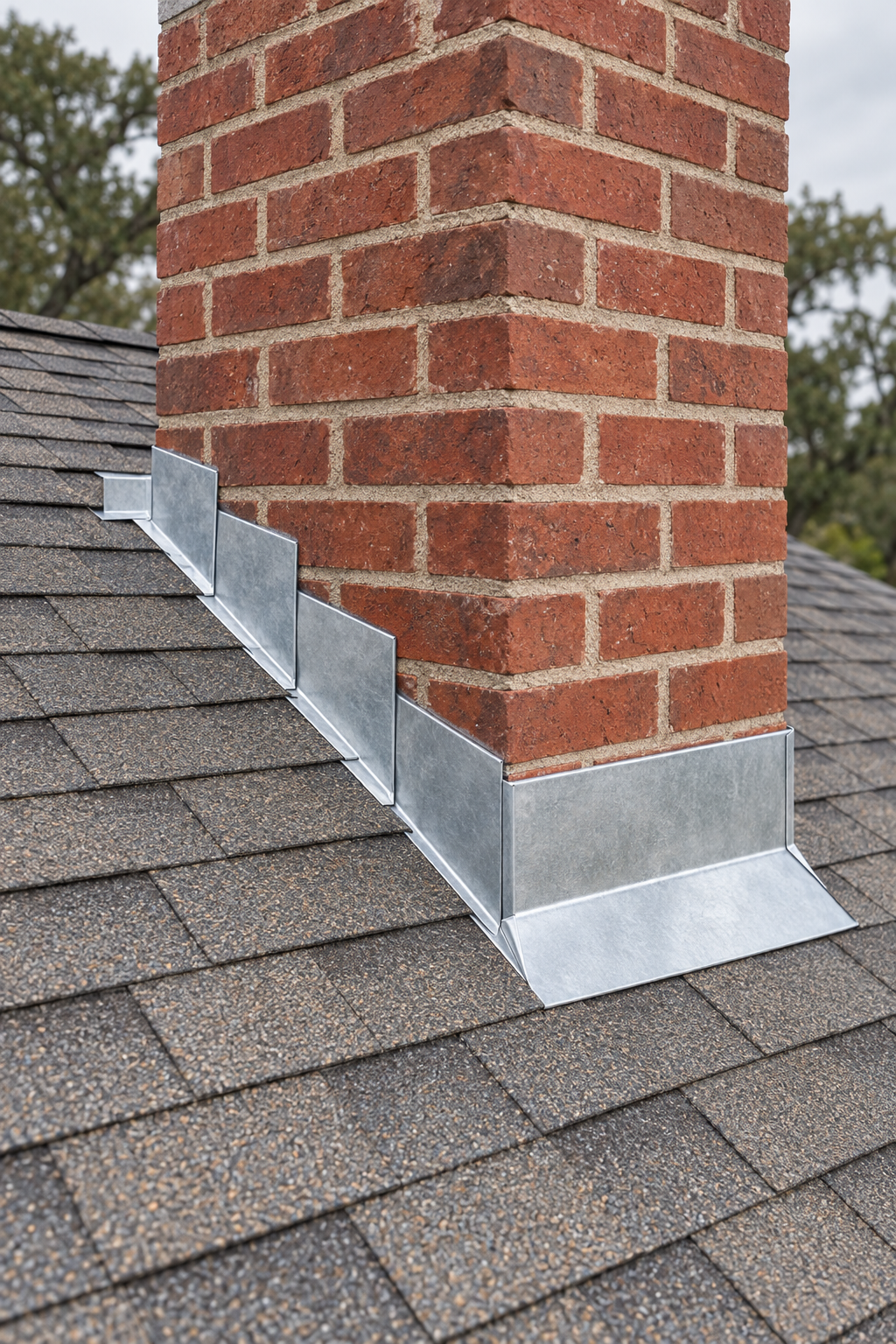
Short bent pieces laid in with every course where a slope runs up a side wall, each one lapping the piece below so water steps down and off.
-
Counterflashing
Also called cap flashing: a strip let into the stucco or chimney mortar that folds down over the step pieces and keeps water from getting behind them.
-
Valley metal
A channel down the inside corner where two slopes meet. It carries the runoff of both, so it handles more water than any other part of the roof.
-
Pipe boot
The rubber collar around each plumbing vent. It splits at the collar long before the roof around it wears out.
-
Skylight flashing
A "curb-mounted" skylight sits on a built frame wrapped in its own metal, and a gap there runs water down the inside of the light well.
skylight repair -
Drip edge
Edge metal along the eaves and rakes that turns water into the gutter instead of onto the fascia, best hemmed and set on a continuous cleat.
Why it fails
Why flashing is the common leak point
Flashing joins surfaces that move and age differently, so it may be the most common point where water gets into a roof.
Movement
Wood framing, stucco and brick swell, shrink and settle at their own pace. The seam between them is where that movement pulls a sealant bead open.
Age
Metal, rubber and sealant wear out on separate schedules, so the collar of a "pipe boot" or a caulked reglet gives out while the shingles beside it still look new.
Debris
Leaves and grit pile up wherever water slows down, behind a chimney and along a valley, and hold it against the metal after every rain.
The order we check when we trace a leak
- Roof edges
- Pipe boots
- Step flashing at walls
- Valley metal
- Hip and ridge cap
The repair
Rebuilding failed flashing to stop a leak
Failed flashing is rebuilt as a detail: the roofing around it is opened, the metal replaced and the joint resealed.
A broken seal or a few displaced tabs is a small course-level fix. A failed boot, a bad valley or open counterflashing is a larger detail rebuild, because that metal sits under the courses and a dab of caulk on top only hides it.
Trace it
We follow the stain on the ceiling back up the slope to the joint that let the water in.
Quote it
You get the whole job in writing before we start, with no surprise charges after.
Rebuild it
New pieces are cut and bent to that joint, and each one laps the next so water runs over the metal, never behind it.
Close it up
Shingle or tile goes back down over the new metal in its own courses, and we clean up when the work is done.
Beyond the basics
More about flashing
Material and a few special joints round out the picture.
A wide chimney gets a "cricket", the small peak built on its uphill side that splits the water around it, and it works only when it is kept clear of leaves. A door that opens onto a deck or a flat roof sits on a door pan, the metal tray that catches what gets past the threshold.
The verdict
Flashing as a job for a roofer
Flashing work should be left to a roofer, because it means walking the roof and opening it up.
Tile breaks underfoot, and any roof is dangerous when it is wet. From the ground, note where the stain shows inside and tell us on the call; that is where we start.
Call Titan RoofingGoogle reviews
What neighbors say about working with us
Reviews from our customers, as they wrote them.
Top notch - Serjio and his team was an absolute pleasure to work with. They were always on time and the most polite and pleasant contractors we have ever had. The whole team went out of the way to make the time at our home as comfortable as possible. I would highly recommend his company.
Thank you. titan roofing I highly recommend them to everybody Five stars all the way
I called Titan Roofing & Rain Gutters inc.for a quote on a residential home, and within minutes they were calling me back and setting up a same day appointment. Sergio came out within the hour and was very professional. He looked everything over and even gave me some great advice in case we ever do experience any leaks. He didn't even have the job but was still willing to help me out.
Water coming in at a wall, chimney or vent?
Call and tell us where the stain is. We trace it to the joint that failed and quote the whole rebuild in writing before any work starts.
We show up when we say we will, and we clean up when the work is done.