
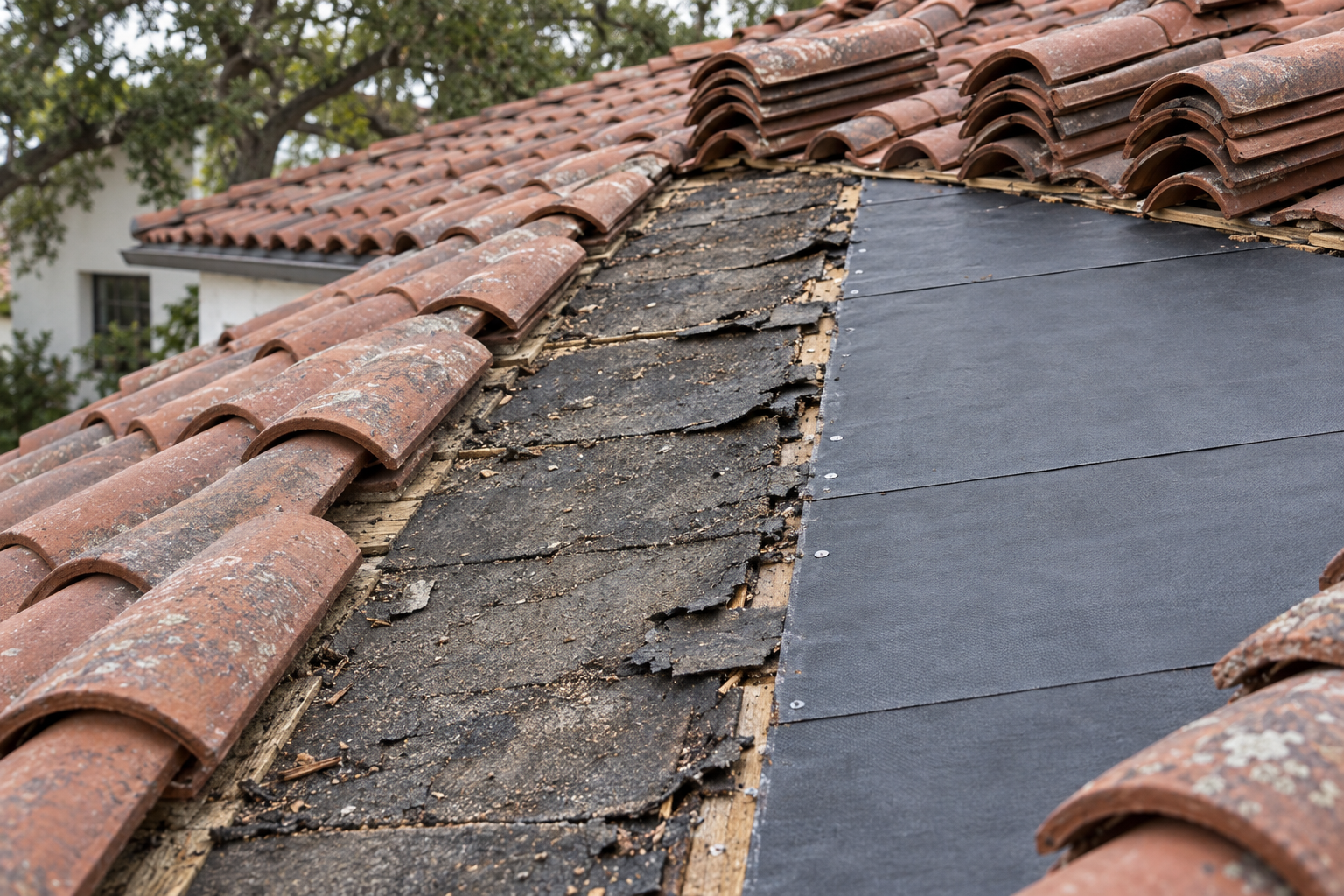
Under tile and shingle
Roof Underlayment: The Layer That Keeps Water Out
The tile sheds most of the rain and the paper under it stops the rest. When that paper wears out, we lift the tile, lay new underlayment and put the sound tile back, with the whole job quoted before we start.
Free, no-obligation estimates in Santa Barbara and nearby. Open every day of the week, with voicemail after hours returned the next working morning.
The short answer
What roof underlayment does
Roof underlayment is the waterproof layer between the roof deck and the tile or shingle, and it is the roof's last defense against water that gets past the surface.
Tile and shingle are a shell that sheds rain, not a seal. Wind-driven rain, a cracked piece or a gap at an edge lets some water through, and the "underlayment" is what carries it down to the eave instead of into the "roof deck", the plywood or boards the roof sits on.
That is why, on a tile roof, the leak is usually the underlayment rather than the tile. Owners call it tar paper, felt or roofing paper; it is the same layer.
- On the tileMost of the water runs off the surface and into the gutter.
- Past the tileWhat blows in or slips through a gap lands on the paper below.
- On the underlaymentThe waterproof sheet carries that water down the slope and off the eave.
- At the deckOnly once the paper has failed does water reach the wood and the ceiling.
What goes under the roof
Felt, synthetic and self-adhered underlayment
Underlayment comes as asphalt felt, synthetic sheet and self-adhered modified bitumen membrane, and the roof and its slope decide which of them goes down.
-
Felt
"Felt" is the asphalt-soaked paper most owners know as tar paper. It is the traditional layer, laid in overlapping courses and nailed to the deck.
Common under older tile and shingle
-
Synthetic
A woven or spun plastic sheet made to resist tearing underfoot while the roofing goes on, and lighter to carry up the ladder than felt.
A newer choice under tile and shingle
-
Self-adhered
A peel-and-stick sheet of modified bitumen that bonds to the deck and seals around the nails driven through it.
Part of our wind-resistant shingle work
Why it wears out
Heat, sun, age and the roof leaks that follow
Heat can age underlayment over decades, and a missing or slipped tile exposes it to sun, which breaks it down quickly.
Under a whole roof the paper wears slowly and evenly. Where a tile or shingle has cracked, slid or blown off, the patch of paper beneath it bakes in direct sun and goes brittle well ahead of the rest.
On tile, a leak in the middle of a slope often means the whole slope has reached the end of its life, not that a single piece broke. A stain that keeps coming back after a patch is usually telling you the same thing.
roof leak repairTile outlasts the paper under it
- Clay and concrete tile
- 75 years or more
- The underlayment beneath
- May fail after 20 to 40 years
So a tile roof that still looks good from the street can be leaking through worn paper.
Call for a Free EstimateWe look at the roof and tell you what the paper needs before any price.
The lift-and-relay
Replacing failed underlayment under tile
On a tile roof the tile is lifted, the underlayment replaced and the sound tile relaid; on shingle the roofing comes off with it.
-
Lift the tile
We take the tile off the worn section and stack it on the roof, clear of the work.
-
Open the deck
With the old paper off, the boards are in plain view, and any "dry rot" a slow leak left behind gets repaired first.
-
New underlayment
Fresh sheet goes down from the eave up, each course lapped over the course below so water runs off, not under.
-
Relay the sound tile
The usable tile goes back in its courses, and only the broken pieces need replacing.
Shingle is different
Shingles are nailed through the paper, so there is nothing to lift and relay. It is a "tear-off" to the deck, then new underlayment and new shingle together.
Why a relay saves money
When tile underlayment has failed, a "lift-and-relay" usually costs less than a new roof, because you pay for labor and underlayment rather than new tile.
tile roofersBefore you call
More about underlayment
Owners also ask whether a roof needs this layer at all, and what that answer means for theirs.
Yes, it is standard
Underlayment as a standard layer
Underlayment is a standard layer of a sloped roof system, and we install it, with the flashing and the roofing, to the manufacturer's standards.
The trade's reference for roofing details is the Roofing Manual from the National Roofing Contractors Association (NRCA). On shingle, the warranties point to the application guidance of the Asphalt Roofing Manufacturers Association (ARMA).
Every day of the week. Voicemail after hours, returned the next working morning.
Call Titan RoofingTell us where the stain shows up and what the roof is made of.
- Free, no-obligation estimates
- We quote the whole job before we start, with no surprise charges after
- We clean up when the work is done
Google reviews
Neighbors on working with us
Reviews from our customers, as they wrote them.
Top notch - Serjio and his team was an absolute pleasure to work with. They were always on time and the most polite and pleasant contractors we have ever had. The whole team went out of the way to make the time at our home as comfortable as possible. I would highly recommend his company.
Thank you. titan roofing I highly recommend them to everybody Five stars all the way
I called Titan Roofing & Rain Gutters inc.for a quote on a residential home, and within minutes they were calling me back and setting up a same day appointment. Sergio came out within the hour and was very professional. He looked everything over and even gave me some great advice in case we ever do experience any leaks. He didn't even have the job but was still willing to help me out.
Paper giving out under the tile?
A call sets the visit. We check the layer under your roof, tell you whether a repair or a relay fits, and quote the whole job before we start.
We answer the phone or call back the same working day, and we show up when we say we will.